Category: Economy

  • Youths urged to develop greater sense of responsibility

    Youths urged to develop greater sense of responsibility

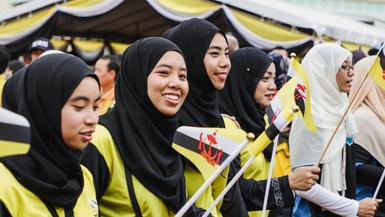
    THE theme “My Country, Brunei Darussalam” certainly carries a very aptly patriotic message to the citizens and residents of the country, which is angled towards a particular emphasis to the country’s future generations of leaders – its youth.

    Speaking to the Bulletin yesterday, the Deputy Minister of Defence, Dato Paduka Hj Mustappa bin Hj Sirat, highlighted: “The theme is very relevant in that His Majesty the Sultan and Yang Di-Pertuan of Brunei Darussalam, in his National Day titah, listed out his vision for the country’s progress and development to ensure improvements and continuity of the country’s peace, stability and prosperity, of which the responsibility should be shouldered by each and every one of us. The message was strongly conveyed to the younger generation to pick up this responsibility by nurturing a sense of duty to the country and our people and play their roles as the future leaders of our country, under the leadership of the monarch.”

    Speaking more towards the younger generations, Dato Hj Mustappa urged them “to heed His Majesty’s call to look after our country by being fully responsible in utilising all the privileges that we, as citizens of Brunei Darussalam are lucky to have, such as the subsidies that the government provides to the people that should not be wasted”.

    However, he noted that the government cannot go about it alone.

    “To ensure all this, we need to intensify our economy, through diversification, but we are still relying on oil and gas,” he said. “This is where the younger generations have a greater role to play, in fact, a bigger role in diversifying our economy.”

    He went on to say that “we’ve achieved another remarkable year by being united under the leadership of His Majesty, and we’re busy actively implementing government policies to ensure that the citizens continue to enjoy the prosperity and welfare of the country”.

    Dato Hj Mustappa acknowledged the countless numbers of younger citizens that work and strive everyday to improve upon the country’s continued peace, progress and prosperity. But he also stressed the importance of feeling a “sense of pride and sense of belonging to a country that remains ‘peaceful, prosperous and developed’”.

    “This is our country. It’s the only country we have and so we have a responsibility to look after it,” said the deputy minister.

    “If not us, who else is going to be responsible for looking after it and taking care of it.”

    Meanwhile, the Acting Deputy Commissioner of the Royal Brunei Police Force, Bahrin bin Mohd Noor took the opportunity to highlight the theme of this year’s National Day Celebrations, “My Country, Brunei Darussalam”, as being “very apt”.

    He also urged all the citizens and residents of Brunei Darussalam, particularly the younger generations, to protect the country, to always remain loyal to the monarch and uphold and nurture the principles of the Malay, Muslim, Monarchy (Melayu Islam Beraja, MIB) national philosophy and, above all else, “to maintain a sense of belonging to each other and our country”.

    Focusing further on the issue of law and order, especially in light of the recent report of increasing crime in some parts of the country, the Acting Deputy Commissioner said: “In this day and age, we are currently seeing many deteriorating social issues, particularly the experiences of crimes. I urge and hope that the youth continue to remain aware of avoiding and refraining from any criminal involvement.”
  • Education key to making future better world

    Education key to making future better world

    One of the 11 fellows of the Southeast Asian Press Alliance, Aquiles Zonio, who hails from Mindanao, Philippines, is in the country to learn more about the local situation regarding freedom of the press. Having invested 25 years in the media profession, Zonio, a correspondent for the Mindanao Bureau of the Philippine Daily Enquirer met up with the Bulletin to share his findings and ask a few questions of his own.

    “The main purpose of my visit here is to do a story on the real press freedom situation in Brunei. Based on my own experience, I can say that the Bruneian media is enjoying more freedom than what we are experiencing in the Philippines,” noted the Filipino scribe who received a fellowship grant from the press organisation that promotes and protects press freedom in the region.

    Elaborating on this profound comparison, bearing in mind that the Philippines often regards itself as the champion of press freedom in the region, Zonio explained: “There can be no real press freedom if journalists exist in a state of fear, poverty and corruption, which is prevalent, not only in the Philippines, but also in several other Asean member countries. I spoke to several colleagues in Brunei and they told me that they were not harassed or intimidated by the authorities for writing any sort of sensitive stories. ‘We are free to write any sort of story we want without fear of such reprisals from the authorities,’ they acknowledged.”

    Zonio, who is perhaps best known for being one of the three journalists to have survived the bloody Maguindanao massacre in 2009, where 58 innocent civilians were brutally gunned down in cold-blood by the Ampatuan clan, of which 32 were journalists, pointed out “journalism is not just a mere profession, it is a volition and it entails lots of sacrifices”.

    He went on to admit that as a journalist, “the personal experiences are not high paying but, you will find contentment and self-fulfillment and that is one thing that money cannot buy. There is no price tag for it”. Having covered the political affairs of the Philippines and the civil war in the Mindanao region, Zonio has amassed a wealth of experience. Asking him why he continues with this potentially fatal profession, he quipped: “The journalists in the Philippines, not all, do not really receiving high salaries, especially provincial journalists like me and unlike you journalists here in Brunei who receives handsome salaries. We, Filipino journalists, are just handsome but not in terms of the salaries.”

    Even before the Maguindanao massacre, his conviction and determination to get the truth out of covering high-profile corruption cases, injustice, illegal gambling, illegal mining, to which he received several death threats and libel cases for his noble efforts, ever since 2004: “I have to carry a gun when walking out in public to protect myself and I always keep a gun under my pillow when I sleep because the state cannot protect us and I don’t trust our law enforcement agencies. But being here in Brunei, it is the first time that I have experienced sleeping at night without having to worry about locking my door. I cannot do that in the Philippines or several other Asean countries.”

    Putting his career into a more philosophical perspective, he explained that by exposing the truth, “in the Philippines, you are putting one foot in harm’s way and this has happened to me, of receiving death threats since 2004. But I am lucky that I am still alive. I hope that I can live out the rest of my natural life and to die naturally, and not by ‘accident’ because I believe that God has a plan for every human being”.

    In his personal view, “freedom cannot be absolute because it comes with responsibilities. Our main objective as journalists is to serve the people, in other words, what we do is a public service. We are the fourth estate. When the other three branches of government go down, it is us as the fourth estate that has to give our voice to the visions of injustice or criminality. The media everywhere should always help the government attain the common good by publishing fair, accurate and balanced information. If the media cannot do that, then it poses a big question mark to our existence and worth”.

    Asking him the latest update in the quest for justice following the Maguindanao massacre, Zonio explained that he was optimistic that justice would eventually be reached, “maybe not today or soon, but maybe in 20 or 30 years time”. Surprised with his answer, he further spelt out: “We need to be patient. We need to make sacrifices. It is not easy to get the justice that you deserve in a country where the judicial system has double standards that is based for the rich, but we have to fight back through the legal process. But it may take three to five generations before we will see any real change. So why are we doing this? Not for our own sakes, but for the benefit of our children and their future.”

    Discussing some other aspects of his travels and experiences, he surmised that there is indeed much prejudice and misunderstanding around the world. “But there are a lot of commonalities. And the only thing that can change all that is education.”

  • Providing jobs necessary duty

    Providing jobs necessary duty

    “HAVING a job is not only about earning a living but equally important it is about honour and it is about self-respect and self-esteem,” said Pehin Datu Singamanteri Colonel (Rtd) Dato Seri Setia (Dr) Awg Hj Mohd Yasmin bin Hj Umar, Minister of Energy at the Prime Minister’s Office, as he laid emphasis on the focus and goal of the Oil & Gas Job Fair 2011 yesterday.

    Inaugurating the country’s first-ever five-day job fair, which is being held at the BRIDEX Exhibition Hall and specifically geared for the oil and gas industry, the Energy Minister at the Prime Minister’s Office set the scene for what the event was all about by emphasising that Brunei’s peace and prosperity were blessings from Allah the Almighty from which “we cannot be complacent or take it for granted” and that these blessings were also “the result of the hard work, wisdom and leadership of His Majesty the Sultan and Yang Di-Pertuan of Brunei Darussalam”.

    Pehin Dato (Dr) Hj Yasmin went on to underline His Majesty’s recent birthday titah whereby the monarch spoke of the need for “planning of human resource development (to) be more composed” as “the world is facing an extraordinary challenging future”.

    Zeroing in on the monarch’s point, the minister reminded everyone involved in the oil and gas industry’s public-private partnership “to grow our economy and to provide employment opportunities to the young generation”, where in this day and age, “having a job is one of the ingredients to make a person a complete being”.

    Pehin Dato (Dr) Hj Yasmin called on the industry to change their recruiting mindset and to take responsibility “to ensure we will all continue to enjoy the peace and share the prosperity”, which “should not be regarded just as a by-product of your business activities but rather it is your duty”.

    As spelt out in the country’s recently-published Energy White Paper, the energy sector is aiming for a target of 50,000 employment opportunities by 2035, of which 5,000 have been allocated for professional Bruneians, 35,000 skilled or semi-skilled workers and the remaining 10,000 specifically filled by guest workers, whereby the main growth areas for these employment avenues, other than in the upstream industry, would be provided in the downstream industry, as well as the oil and gas service sector.

    “Today we already have around 15,000 employment opportunities in the oil and gas service sector but, unfortunately, only 40 per cent are Bruneians,” the minister pointed out. He further hammered home the point that other than creating more job opportunities, “equally important, we must create good quality jobs that pay reasonable salary and offers career development opportunities”.

    Pehin Dato (Dr) Hj Yasmin then listed out the key initiatives that the Energy Department at the Prime Minister’s Office would implement in further ensuring the success of this ambitiously noble project.

    An overarching Energy Industry Competency Framework to align the training needs with the industry’s requirement is currently being prepared, in collaboration with the Ministry of Education, as well as the Department of Economic Planning and Development, to ensure that training providers have the capacity to generate competent Bruneians for the jobs offered by the industry.

    What the minister had in mind were not only those with the technical knowledge and skill to meet the industry’s standard but also “those who have the right attitude and personal and leadership skills”.

    The second capacity-building initiative, following the consent of His Majesty, is the formation of the Brunei National Energy Research Institute (BNERI) that is hoped to provide an avenue for local scientists, engineers and business leaders “to develop our energy industry to a new level and be able to compete within the region”. It also serves to provide a platform for research work with the industry that could be “patented within the country and with this, commercialisation of its associated products and processes” that would further open up another avenue career path for Bruneians.

    A new Local Business Development framework will also be introduced early next year that will regulate the creation of a more conducive environment for local companies by motivating them to employ more local talent as a means for them to be “more genuinely involved in the oil and gas sector”.

    The fourth initiative is the facilitation of more key investments in the industry to spur on more local business opportunities as a way to generate more employment opportunities.

    Although the minister admitted that many of these new initiatives would “take a bit of time for full implementation”, Pehin Dato (Dr) Hj Yasmin voiced out his hope for the more than 80 per cent of school-leavers without any tertiary education each year “would want to work if you give them the(se) opportunities”, who could then be trained by local companies through the smart and careful utilisation of the government’s Human Resource Development Funds.

    The minister further highlighted the 10,000 employment opportunities currently available that are supported “by our guest workers” and the commitment of business owners and management team “to ensure the continued prosperity of Brunei Darussalam”.

    Pehin Dato (Dr) Hj Yasmin then reasoned that “all the components are here and there should be no reason why we cannot act together and be able to work together to increase jobs for Bruneians”.