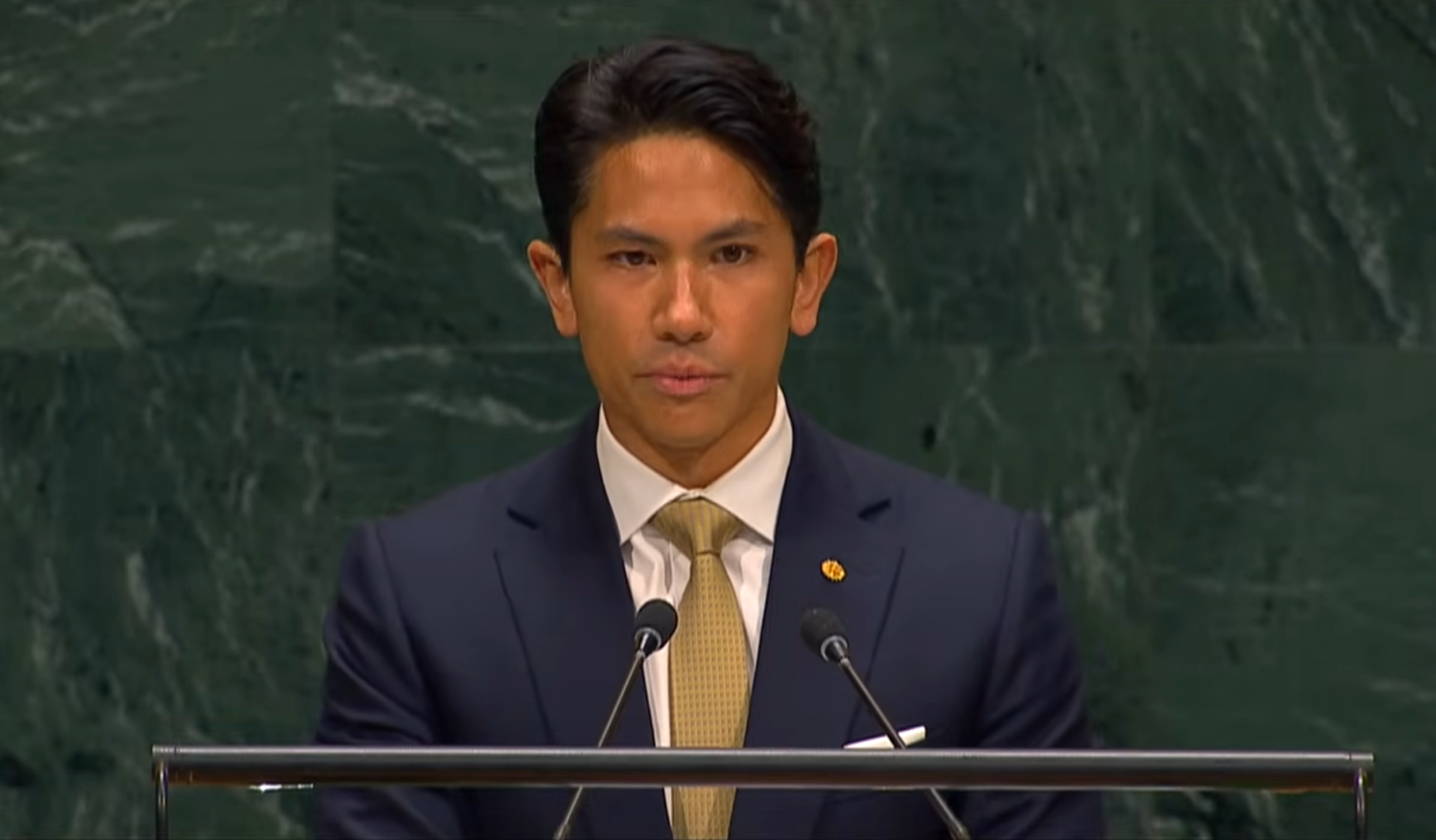
AT THE recent general debate of the 81st United Nations General Assembly, His Royal Highness Prince ‘Abdul Mateen Ibni His Majesty Sultan Haji Hassanal Bolkiah Mu’izzaddin Waddaulah, Minister of Foreign Affairs wasted no time zeroing in on the one word that mattered the most for this year’s assembly – and that word was ‘trust’.
Trust today, His Royal Highness pointed out, is “something the world is losing far too quickly… It is difficult to build, easy to fracture and, once lost, very hard to restore.” All this clearly explains why the majority of the globalised south has been making concerted efforts to create alternate institutions such as the BRICs grouping to steer away from Western-dominated political and financial systems.
At this pivotal juncture where the mind-numbing atrocities three years in – in Gaza, the West Bank, southern Lebanon and now, with the US war against Iran – all taking centerstage in every news outlet and dominating every news flash in our phones, to the point where one cannot help but come to the damning realisation that, “today, we not only see declining confidence between countries, but also a growing crisis of faith in the rules meant to bind us together,” and this, our Foreign Minister pointed out, “weakens us all.”
Speaking for the Sultanate, His Royal Highness highlighted that the issue of broken trust amongst the international community has been demonstrated painfully with the question of Palestine, particularly in Gaza, where “the scale of human suffering and destruction is intolerable. Civilians, including far too many children, continue to bear the heaviest cost”. His Royal Highness further listed medical personnel, journalists, humanitarian workers and United Nations personnel also amongst those killed “while carrying out their duties”. According to official estimates, since October 7, 2023, some 1,700 medical personnel have been killed, with 300 more detained, 263 journalists and more than 560 relief workers, out of which 393 were staff belonging to the United Nations Relief and Works Agency itself, and never forgetting the 77,000 men, women and children who have lost their lives – and those numbers continue to rise every single day.
Calling out the double standards that has galvanised much of the world’s population against the injustice in Palestine, His Royal Highness warned the assembled delegations from 192 member states that: “For generations, the Palestinian people have waited for justice, statehood and dignity.” Pointing out that the already staggering numbers of killed, wounded and maimed “are not merely numbers. They are human lives,” and warning against the detachment and normalisation of these atrocities.
His Royal Highness went on to point out that the continued suffering of the Palestinian people exposes a fundamental truth – glaringly more so than ever today – that “international law and the principles of the Charter must apply equally to everyone,” and that there cannot be one standard for some, and another for others, echoing many other leaders that called out the increasing double standards of those countries directly or indirectly supporting the atrocities.
“A just and lasting peace,” His Royal Highness continued, “requires addressing its root cause” and delivering the promise made to the Palestinian people that had been pledged decades ago for their legitimate right to self-determination as well as the creation of an independent State of Palestine. For without justice for the Palestinian people, His Royal Highness pointed out: “there can be no lasting peace.”
And it was this very question of Palestine that “remains a defining test of the credibility of the United Nations and, particularly, the Security Council,” His Royal Highness continued to remark; words and sentiments that were also shared by other world leaders, such as Malaysia, Indonesia, Singapore and His Majesty the King of Jordan himself, to name a few.
As a serving military officer, His Royal Highness also highlighted the risks to the seven thousand strong peacekeeping contingents, deployed from 46 UN member countries. “The conflict is no longer confined to Palestine, His Royal Highness remarked, where its escalation and consequences have spread across the region. “In neighbouring Lebanon, United Nations peacekeepers have also lost their lives while serving the cause of peace.” Four Indonesians, two French and one Serbian peacekeepers have been killed in southern Lebanon since it was invaded in March this year, with 21 more injured in the line of duty, where the UN could only express ‘deep concern’. The Royal Brunei Armed Forces currently has a contingent of 21 soldiers deployed there – to date, all confirmed safe by the Ministry of Defence.
“It is in this wider context that Brunei Darussalam co-sponsored Security Council Resolution 2823,” His Royal Highness reminded the assembly, “strengthening accountability for crimes against United Nations peacekeepers. Those who serve under the United Nations flag must be protected.” But His Royal Highness cautioned that the issue of accountability cannot be selective. “The protection of those who serve peace, and the protection of innocent lives, especially children, must remain at the heart of this Organisation,” if indeed the UN genuinely wants to rebuild trust.
For a diplomat – as with every responsible and civic-minded adult – words must mean what they say. And those words must also be backed with the correct corresponding action; otherwise those words become lies and those actions, in turn, run contrary to what had been said or promised. For those leaders, ministers and delegations from the 77 countries that walked out just as Israel’s prime minister approached the podium, did somewhat salvage their sovereign reputation in formal protest against the ongoing injustice that continues to be perpetrated by the leader, military and extremists of that state, and it was also indeed a matter of honour and pride for Brunei Darussalam that our young foreign minister also joined that symbolic walkout. And why shouldn’t we? Since independence, the sultanate has not made it a secret that the only country that Bruneian citizens are forbidden from travelling to is Isreal – as we have never recognised it to this day nor have we ever initiated any reason for any diplomatic relation with.
Exactly three years ago, to this day, delegations from almost every country in the world, save one – Palestine, ironically – one cannot help but feel ashamed that they are still debating this travesty that continues to end the lives of far too many lives in Palestine, Lebanon, and now Iran – not to mention the countless others across ongoing war-torn parts of the Middle East, not forgetting victims and casualties amongst the Christian population themselves across this region. Is it not already high time to take more concrete actions? Or must the world wait for the next General Assembly or the one after before these killings stop? The geopolitical turmoil, that has for the most part been unilaterally initiated and sustained, to this day, by the United States and its allies, for all its talk of democracy and justice, is now being felt in every household across the world, from rising food prices, fuel and logistics costs, a potential food crisis and the increasing polarisation between the supporters of the US and its number one ally with the rest of the world. A world that is increasingly growing tired and weary of continuous war and suffering. With each passing day, more and more people across the world are calling out the double standards of the West and their blatant hypocrisy. And yet, the overwhelming antipathy amongst Western leaders seem very content to continue pushing the rest of the world towards oblivion. And this is why we, the people of the peace-loving world must make the change. For to sit back and do nothing makes all of us complicit, in the end, for every innocent life that continues to be slain. We can no longer afford to continue playing this blame game, three years on. For the Palestinians, since 1947 – 79 years ago. And yes, actions have been made, but are they enough? Judging by the increasing chorus of leaders at this year’s General Assembly, the answer clearly speaks for itself. The real question now is what comes next? More of the same? Or will the globalised south finally rally together to make good on their words in New York to actually rebuild trust?
With the official debut of the Sultanate’s new foreign minister at the world’s most prestigious stage – the United Nations annual General Assembly – His Royal Highness Prince ‘Abdul Mateen has proven his maturity and mettle most eloquently not just in front of all the assembled heads of states and governments but, more importantly, to the millions watching that debate – with hopes of a lasting and just solution to this perennial problem in the one of world’s longest and bloodiest quagmires. Addressing the assembly, His Royal Highness aptly singled out the most critical point of this problem and that is trust. Trust that is eroding so fast within the span of almost three years since October 7 that the world’s former superpower is now still begrudgingly unwilling to accept that the world no longer wants to listen, subscribe or even believe in. As His Royal Highness mentioned, rebuilding this trust should not mean returning to the status quo ante but rather equipping ourselves to face the world that is now emerging. I am Waleed Pehin Dato Hj Mahdini, reporting for TNBD.